PivotMath, which I designed and developed, is an interactive platform that serves as a guided practice tool for students aiming to enhance their middle school math abilities. It offers exercises rich in illustrative examples that incorporate essential mathematical principles, concepts, and techniques. To provide further insight into the platform’s value, I created the following video demonstrating how it operates. If you have any specific questions about PivotMath or need more details, feel free to ask:
AT A GLANCE
Comprehensive, Illustrative Exercises
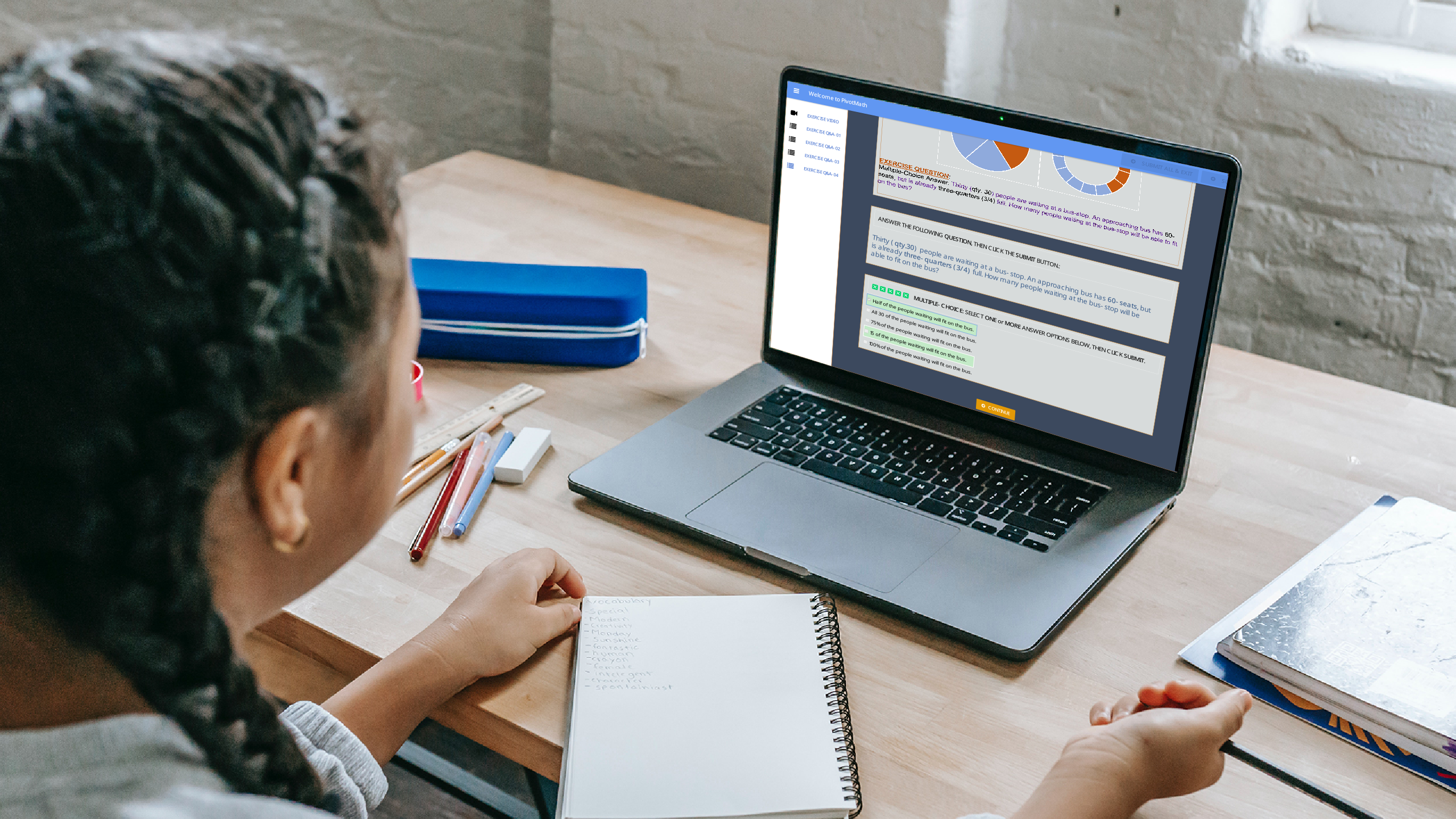
For a selected Grade, Subject and Skill, the student is initially presented with a mini-skills review Video, followed by targeted Exercises in batches-of-10. Each Exercise, in turn, is a complete package comprised of: A mini-skills Review section ● A Problem to solve ● Its step-by-step work-along Hint, and ● An area to submit a True/False, Numeric, Multiple-Choice, Single-Choice answer. When student struggle is detected, PivotMath offers to unveil the work-along Hint. In contrast to workbook, question-bank and quizlet study, these comprehensive Exercises along with content-sequencing, catalyze student discovery along the solutions journey.
Guided Practice with Encouragement
Students begin each Exercise by studying its Review content, then advance to its companion Question. If the student idles on the Question for 5-minutes, PivotMath offers to reveal its step-by-step work-along Hint, which can be accepted or deferred. If deferred, the offer repeats every 5-minutes until it is either accepted or an answer is submitted. Once an answer is submitted, PivotMath reveals: An Encouragement card indicating the outcome (i.e., correct or incorrect) ● The correct answer(s) ● The step-by-step work-along Hint, and ● The unique Exercise URL for bookmarking and later reconsideration. With this additional detail students can, perhaps with an instructor, reconsider the Exercise more carefully. Students can also mine previous Exercises in the batch for concepts, ideas and clues that may help solve the current question.
MORE …
Individualized Auto-Pivot Pacing
By design, students are always in control and can spend as much time on an Exercise as necessary – there are no timers by intent. However, PivotMath maintains an internal scorekeeper that automatically pivots students through successive math-levels as passing scores are achieved. This enables PivotMath to align its pace to student aptitude.
Summary Email with CSV attachment
At the end of each PivotMath session, an email is dispatched to both the student & instructor with per-exercise detail, including: The exercise URL ● The answer outcome ● If its hint was revealed ● The amount of time spent on it ● And the scoreboard average after submission. This feedback helps unearth problem areas as well as progress.
Customized Exercise Packs
You can precisely target your student’s needs by ordering customized PivotMath exercise packs.
Multipurpose Instructional Settings
Extracurricular Practice ● Home & Pod Schools ● Class Pop-Quizzes ● One-on-One Tutoring Content ● Substitute Teacher Activity ● Placement Assessment ● Post-Secondary Math Remediation (e.g., College, Military, etc.) ● and more.
PHILOSOPHY
Huddled beneath lanterns, scholars of yore — Descartes, Newton, Leibniz — forged enduring laws and theories with little more than scribes, quills and tattered texts. With faculties acutely focused — unblemished by AI, rules-of-thumb education and other gimmicks of modernity — these luminaries resolutely toiled over problems until solved. This unrelenting manner is profoundly captured in the classic “How to Read a Book” (M. Adler, et al., 1972), as it asserts what is mandatory towards elevating one’s understanding:
Let us assume that you do not understand a book perfectly. Let us even assume – what unhappily is not always the case – that you understand enough to know that you do not understand it all. You know the book has more to say than you understand and hence that it contains something that can increase your understanding. What do you do then? You can take the book to someone else who, you think, can read better than you, and have him explain the parts that trouble you. “He” may be a living person, a commentary or textbook. Or you may decide that what is over your head is not worth bothering about, and that you understand enough. In either case, you are not doing the job of reading that the book requires. That is done in only one way. Without external help of any sort, you go to work on the book. With nothing but the power of your own mind, you operate on the symbols before you in such a way that you gradually lift yourself from a state of understanding less to one of understanding more. Such elevation — accomplished by the mind working on a book — is highly skilled reading, the kind of reading that a book which challenges your understanding deserves.
Every feature of the PivotMath application and every reinforcing exercise it emits, are voices of this philosophy. PivotMath’s return-to-fundamentals doctrine compel students to synthesize ideas on their way to solving concept-and-principle infused Exercises. These sustained experiences of pure-concentration — one immersive Exercise after the next — is PivotMath’s road to mastery.
MISSION
PivotMath refers to its namesake platform and purpose, which is helping pivot-aged Middle Schoolers (6th, 7th & 8th graders) pivot through successively higher math-levels. We endeavor to elevate core math principles, concepts and techniques known to them – including ones considered early primers for Calculus – through an expanding repository of high-quality Exercises, each comprised of Review, Question and work-along Hint content specially designed to provoke critical thought.